


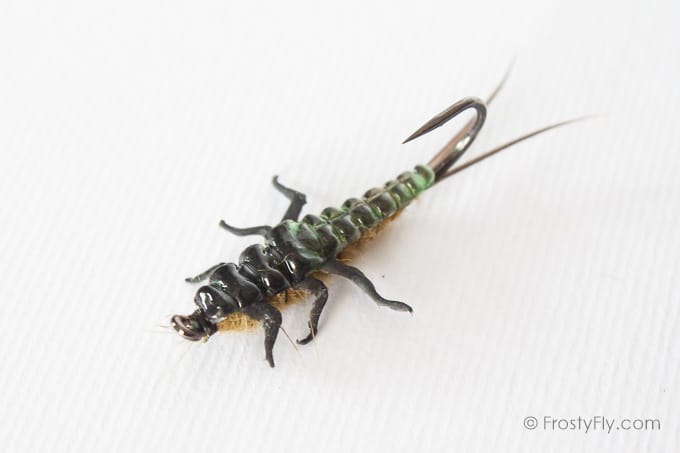
Upside Down Realistic Stonefly Nymph
Stonefly nymphs spend their lives crawling along the riverbed—and this fly is built to do the same.
The Upside Down Realistic Stonefly Nymph is defined by its inventive point-up hook design, allowing the fly to ride with the hook point facing upward. This smart construction significantly reduces snagging in rocky, fast water while keeping the fly tracking naturally along the bottom—exactly where trout expect to find stonefly nymphs.
Carefully weighted, the fly drops quickly into the strike zone and stays there. The upside-down orientation also improves stability, helping the fly drift cleanly and maintain a natural posture even in heavy current.
Realism is taken a step further with a molded, segmented shell that accurately mimics the stonefly’s natural body shape. Soft silicone legs add constant motion, while a biots tail and hand-selected dubbing complete the profile with subtle detail that trout respond to instinctively.
This pattern doesn’t just look realistic—it behaves like the real insect, crawling, tumbling, and holding close to the substrate. The result is a fly that fishes hard, stays productive longer, and consistently draws confident strikes.
Key Advantages:
- Inventive upside-down, point-up hook design for fewer snags
- Fast-sinking weight to reach bottom-feeding trout quickly
- Stable bottom-tracking posture in strong current
- Highly realistic molded shell and segmentation
- Flexible silicone legs for natural movement
Available Options:
- Colors: Black, Golden, Yellow, Tan, Brown, Orange, Green, Olive
- Hook Sizes: #6, #8, #10
Also available as an assorted set of 10 flies, covering a practical mix of colors and sizes for varied conditions.
Approximate Fly Weights:
- #6: 0.8 g
- #8: 0.6 g
- #10: 0.46 g
Fishing Tips: How to Fish an Upside-Down Stonefly Nymph
1. Fish it with confidence near the bottom
The upside-down design allows you to drift this fly closer to rocks and structure without constant snagging—use that advantage.
2. Ideal as a lead fly
Run it as the anchor fly in a two-fly nymph rig. Its weight and orientation keep both flies tracking naturally.
3. Excel in fast and technical water
Pocket water, riffles, and boulder fields are where this pattern shines. Let it tumble naturally with the current.
4. Tight-line or indicator both work
Equally effective in Euro-nymphing setups or under an indicator—adjust weight to maintain bottom contact.
5. Choose a size for conditions
Larger sizes in high or dirty water; smaller sizes when flows drop and trout get selective.