


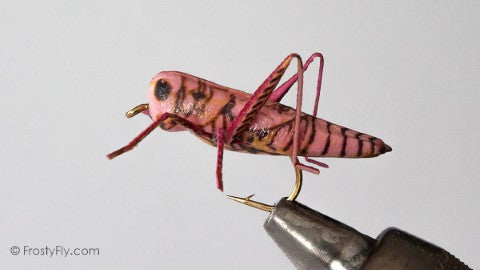
Realistic Hopper (Grasshopper)
The Realistic Hopper from the Vania Flies collection is designed to closely imitate the profile, posture, and movement of a natural grasshopper. Built from lightweight foam with a durable silicone coating, it combines excellent flotation with the flexibility needed to create subtle movement on the water.
Every detail has been carefully designed, from the realistic body shape and natural proportions to the flexible legs that move naturally with every drift, twitch, and ripple. The result is a convincing terrestrial pattern that fishes naturally throughout the drift while remaining buoyant, fish after fish.
Despite its realistic appearance, this is a practical fishing fly built to be used. The durable materials stand up well to repeated takes, while the balanced construction helps it land softly and ride high on the surface.
Whether you're fishing grassy banks, windy afternoons, or the late-summer terrestrial season, this is a pattern you'll reach for with confidence.
Realistic Hopper is available in 8 proven colors, and three hook sizes: #6, #8, and #10.
Winner of the Best Terminal Tackle Award at the 2015 EFTTEX.
Also available as a 10-fly assorted set featuring a practical mix of colors and hook sizes.
Hopper Fly Fishing
Hoppers (grasshoppers) are ground-dwelling terrestrials from the order Orthoptera with powerful hind legs that enable them to jump energetically. They are large and bulky insects that often find themselves in the water, where they start drowning the instant they hit the water. When in water, they would start vigorously struggling, kicking, and splashing. Accurately imitating these movements of the fly on the water surface can be an imperative part of your presentation. Dead-drift floating with an occasional twitch can produce some ferocious strikes from sizable trout. Hoppers are big meals, so they usually 'bring the largest fish to the table'.
Adult hoppers hit their peak activity and reproduction from late June through October, sometimes even into November for some species. Great times for presenting this fly are during warm and breezy midday and afternoon. They are most active on the hottest days of the summer months. At the same time, these are the days when the water temperatures are warmest, and water levels are the lowest, the times when even the largest of fish come out for some easy, large meal.
Hopper Fishing Tip: When fishing with hopper patterns, throw your fly within a few inches of the water's edge. Moving a few inches closer to the bank could be crucial when fishing with these flies.
Fly Fishing Terrestrial Flies
Terrestrial insects are land-bred. Some of the species of terrestrials include: hoppers (grasshoppers), ants, beetles, bees, crickets, etc. Terrestrials are one of the essential food sources for trout and other game fish during the summer months. Hot summer months are when the aquatic insects become sparse, the trout are the most active, and grow the fastest. This is when terrestrials become their most important food source as a rich source of protein. A terrestrial falling into the water is a great and nutritious meal for fish, as these insects are usually bulkier and heavier than aquatic insects, and they provide a large calorie intake when the trout need it most.
Terrestrial fly patterns are effective from May to October, and sometimes even into November. As terrestrials are most active and most likely to fall in the river during the day, the best time to fish these fly patterns is anytime from late morning all the way through the evening. Windy days are best as the wind pushes them to the water. Optimal locations to present terrestrial patterns are along cut banks, grassy shorelines, or under big trees, places where fish wait for their easy meals, just dropping in. As these insects will eventually be pulled further into the river, midstream can also be a good place to present your fly.
On smaller streams, fish depend mostly on terrestrials as their food source. Small waters don't have the high-energy riffles where the aquatic insects spend much of their life cycles. For fishing small streams, terrestrials are a must. Being it mid-summer, early fall, or the midst of spring, fishing terrestrial fly patterns can provide top dry-fly action!