


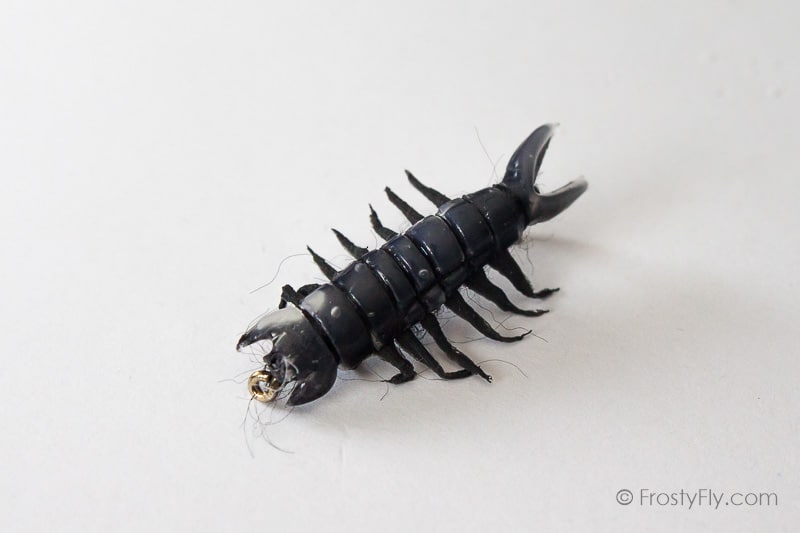
Realistic Hellgrammite Fly
One of the most realistic hellgrammite patterns for targeting trout and smallmouth bass.
Our Realistic Hellgrammite Fly is designed to closely imitate the appearance of a natural hellgrammite, one of the largest aquatic insects found in many rivers. Its realistic profile, segmented body, prominent side legs (filaments), strong mandibles (jaws), and authentic body markings create a convincing imitation that fishes naturally along the bottom.
Made from flexible, durable materials, the legs and body retain their shape while producing subtle movement in the current. Additional dubbing beneath the body enhances the fly's natural silhouette and movement without adding unnecessary bulk.
Weighted to reach the bottom quickly, this pattern is ideal for fishing through riffles, rocky runs, and deeper pockets where hellgrammites naturally live.
Available in the two most common natural colors: Brown and Black.
Hook size #4, weight 1.65 g (0.06 oz).
Hellgrammite Fly Fishing
Hellgrammites are the larval stage of the dobsonfly (family Corydalidae), large aquatic insects belonging to the order Megaloptera. While the adult dobsonfly is of little importance to fly anglers, the larval stage is one of the largest and most nutritious aquatic food sources found in many rivers.
Dobsonflies typically emerge on rocks, logs, or streamside vegetation just above the water. Before reaching adulthood, they spend two to three years as hellgrammites, living among rocks and debris in clean, well-oxygenated, fast-flowing streams. They are active predators, feeding on other aquatic insects, and are known for their ability to crawl along the streambed and move both forward and backward.
Because hellgrammites spend most of their lives close to the bottom, the most productive way to fish these patterns is near the streambed. They become especially vulnerable when dislodged by current and carried downstream in a natural drift.
Dead-drifting a hellgrammite pattern close to the bottom is usually the most effective presentation. Letting the fly tumble naturally through riffles, rocky runs, and deeper pockets closely imitates the movement of a real hellgrammite. A gentle swing or slight lift at the end of the drift can also trigger strikes, particularly from aggressive trout and smallmouth bass.