


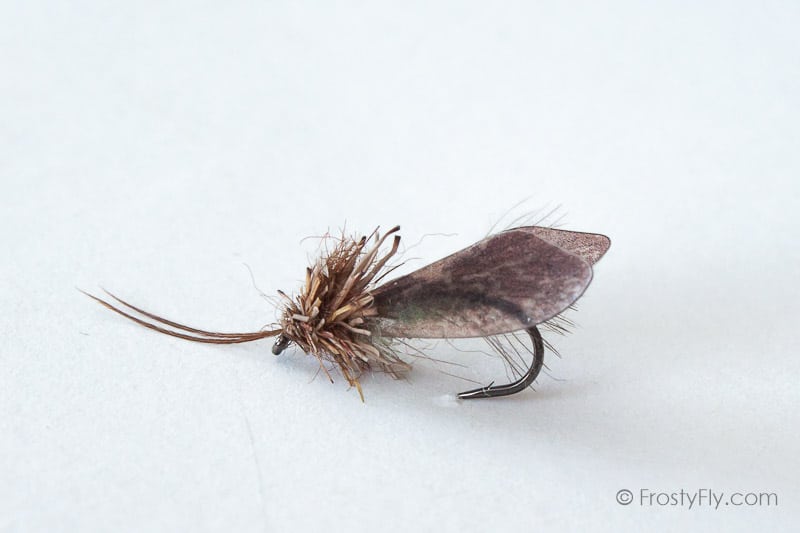
Realistic Caddis Fly Dry
Realistic Caddis Fly Dry - a life-like imitation of a real caddis adult coming from Hemingway's. Features the lightweight, tent-like shaped wings, made from flexible and transparent material, and finished with authentic, real-life details and printing. The body has been tied with a premium-grade dubbing blend that floats great. Spiky hackles around the head and two antennae create a more authentic look. The pattern has just the perfect weight and has great floating capability. This will soon become one of your favorite patterns - it is super effective even when your trout is a bit selective.
Comes in Brown, Cinnamon, Gray, and Black and hook sizes #10, #12 & #14.
Caddis Fly Fishing
Caddis flies are one of the most important species when it comes to trout food. They become most significant for fly fishers in the late spring and early summer, with the peak in the summer months, continuing into the fall. Fishing dry caddis patterns works well during caddis hatches and during their egg-laying flights.
Caddisflies are an aquatic insect that undergo a complete metamorphosis; they go from egg to larvae, then to the pupal stage, and finally emerge as an adult. Most species go through this full process over the span of one year. Out of all the stages, the larval stage is the longest, taking about a few weeks to a few months.
When caddis larvae start hatching, this is when they become most vulnerable in their life cycle. In this stage, emerging caddis pupa start drifting as they make their way rising to the surface. During this time they are going through the whole metamorphosis; their shuck splits open as they struggle to get out of it and emerge as adult, flying caddis. Adults live longer than other aquatic insects, one to four weeks, usually in the bushes along river banks. One of the reasons they can live longer as adults than other aquatic species (like mayflies) is that they are able to drink water they stay hydrated during their adult life.
Adult caddis flies are found in great numbers. Their specific down-wing, tent-like shape differentiates them easily from other aquatic species. Their wings are hairy. They don't have tails, have long antennae and segmented, stout, fat bodies that are shorter than their wings. They range in size, but the most common species are between 12 and 16.
Caddis flies mate outside water, in the vegetation, and males usually die on dry land shortly after. Females fly back to the surface to deposit eggs, after which they can be found on the surface floating helplessly. These spent females become an easy target for trout. These are scenarios that fly fishers need to replicate when dry fly fishing caddis patterns. To emulate an adult caddis floating on the surface with its wings still, dead-drift with no drag would be the most effective presentation.